.png)
CACTUS AIR-CARE ECOSYSTEM FOR KIDS

Overview: Cactus is a product family with three different models designed for use in environments where children are concentrated (classroom, nursery, home, etc.), working as both an air purifier and a humidifier.
Timeline: Summer 2025 (14 weeks)
Role: Design of the entire concept (product + brand + digital)
Scope: Product Design, packaging, brand identity, website, mobile application
Toolkit: Miro, Procreate, Fusion 360, Blender, Figma, Adobe Photoshop, Freepik

_flipped_edited.png)
Air Purification
Air r Humidifier
Air Purification & Humidifier
Company
Help Center
Pre Order Now



Cactus Family


Air Purifier
Air Purifier & Humidifier
Air Humidifier
Problem Statement
Researching Problem Space
There is a need for an emotionally acceptable, spatially compatible, and functionally reliable air-care product tailored to children’s environments.
Children are physiologically more vulnerable to poor indoor air quality, especially in shared environments such as classrooms and playrooms. However, most existing air purification and humidification devices are designed for adult use — both in terms of aesthetics, functionality, and interaction design.
Through observational research and parent interviews, I discovered that caregivers often struggle to find devices that are both child-safe and emotionally acceptable for kids. The sharp-edged, mechanical, and oversized appearance of typical devices tends to clash with children’s spaces and can cause unease.


There is a clear need for a product that not only purifies and humidifies air, but also harmonizes with the emotional, spatial, and functional needs of children. Cactus aims to meet this need through a modular, child-friendly, and emotionally engaging product family.


In classrooms filled with children, the air quality tends to decline due to the presence of many individuals in a closed space for extended periods. These environments must remain free of airborne particles, dust, and bacteria. Air purifiers designed for classrooms should effectively remove these contaminants while allowing children to be exposed to certain particles, which can help strengthen their immune systems during growth and development.
For schools with inadequate ventilation, this air purifier should not only clean and soften the air but also release pleasant fragrances to mask any unpleasant odors in the atmosphere.
Additionally, classrooms must have clean air while maintaining a humid environment to prevent dryness.

In crowded places such as schools, viruses can spread quickly. One person carrying a virus can infect dozens of children.
Children, in particular, may not fully understand or practice good hygiene, which increases the likelihood of disease transmission.
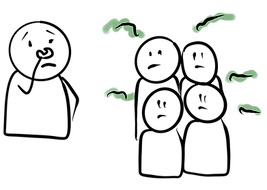
Furthermore, the combination of various odors (such as food, sweat, etc.) in classrooms creates strong and unpleasant smells.

Studies show that air purifiers reduce PM2.5 levels, reducing medication burden in children with asthma.
Interviews & Insights
To better understand the needs of parents and the dynamics of children’s spaces, I conducted informal interviews and short questionnaires with parents and individuals who had previously worked in child-related environments.
1. Parents worry about indoor air quality but forget to control humidity.
👩🏼
What do you pay most attention to in order to ensure air quality in your home?
I open windows and ventilate the room, but to be honest, I never think about the humidity level.
👩🏻🦰
— Parent of a 5-year-old
2. Children often resist devices that feel "clinical" or "tech-heavy".
👨🏻
How do your children react when there is an electronic device in their room?
My kids often shy away from devices that feel “clinical” or “tech-heavy.”
👩🏻🦰
— Parent of two children, ages 7 and 6
3. Existing air purifiers are either too complex or not spatially compatible with playful environments.
👩🏽🦱
How do your children react when there is an electronic device in their room?
The device looks very crude in the room, and its settings are very complicated. It does not suit the child's room at all.
👩🏻🦰
— Parent, age 34

Ideation
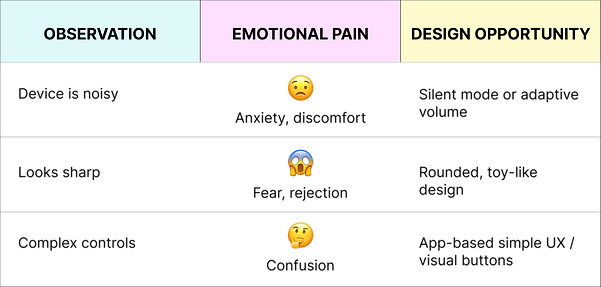
Decision Moodboard
Clear feedback

Interface with emojis

LED Screen

Modular form

App option
Ease of production
Parent + child ease of use

organıc forms
Safe use
Easy control
How do I design a product that is easy to manufacture and consists of similar parts?
Shared parts and simplified internal structures were key to production efficiency. Instead of designing entirely separate devices, I developed a core structure adaptable to all three functions (purifier, humidifier, and combo).
Common parts allowed the use of the same injection molds and streamlined quality control.
Fastening methods like snap-fit connections replaced screws where possible, further reducing assembly time and labor cost.
Sketches
Motivated by the lack of child-friendly, emotionally resonant, and space-conscious air-care products, I began exploring design directions through sketching.
I preferred organic forms in the product to prevent possible injuries to children due to contact.
☁️ Soft form – ⚠️ Safe feel – 🖍️ Child-centered

.jpg)

Why modular design?
The modular design was chosen to optimize the manufacturing process. By standardizing certain components across the product family (such as base casings and control interfaces), I reduced part variety and simplified assembly steps.
This approach minimized the need for multiple molds and enabled efficient batch production, especially valuable for small to mid-scale manufacturing.
Storyboard
_edited.png)
The child's room air becomes dry
Cactus starts automatically
The mother recieves an alert
_edited.png)
The child interacts with it
The mother controls it via the app
The cactus flower inspired me to create a room fragrance. The design of the flower symbolizes lovely scents while enhancing the freshness of the room when placed near a fresh air outlet. Its mechanism is similar to how car air fresheners are attached to air conditioning panels.
Home Fragnance


Colours
When developing the brand identity, I considered which colours would be suitable for the product. Since I envisioned it being used in a school environment, I wanted to select colors that would appeal to children and young adults.
The colour tones inspired by cacti were particularly effective in connecting with my target audience at this stage. I began by creating a colour scheme based on cacti.
#B7CBB3
#0F5940

#9B9ABC
#80597A

#FF915C
#CB3B3C
As a result, I identified three primary colors and created variations for each, resulting in a total of six color options. I chose dark green (#0F5940) as the main color, envisioning it to be used in elements such as the logo and box design.
Final Sketches
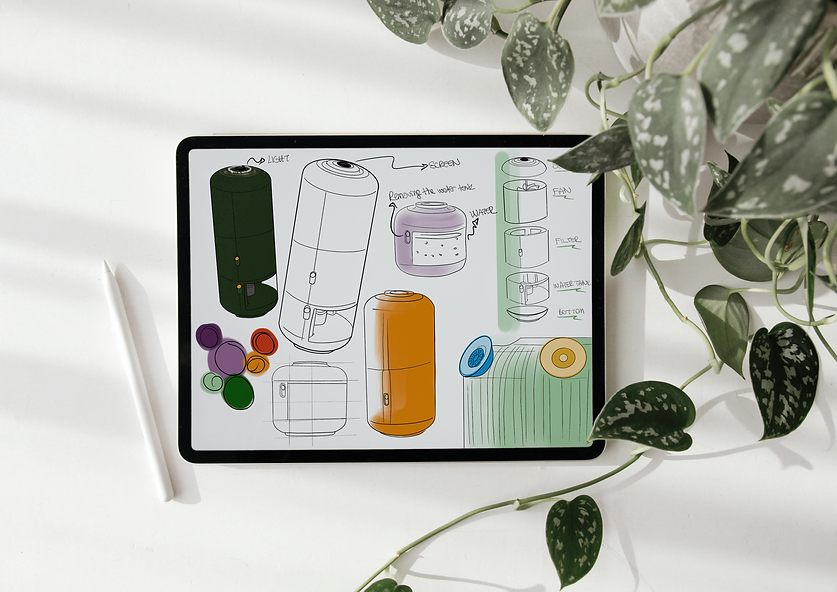
Product Details
Usage Scenario
SCREEN FEEDBACK


Cactus' lights turn on according to the humidity and air quality index of the air and give feedback to the user.
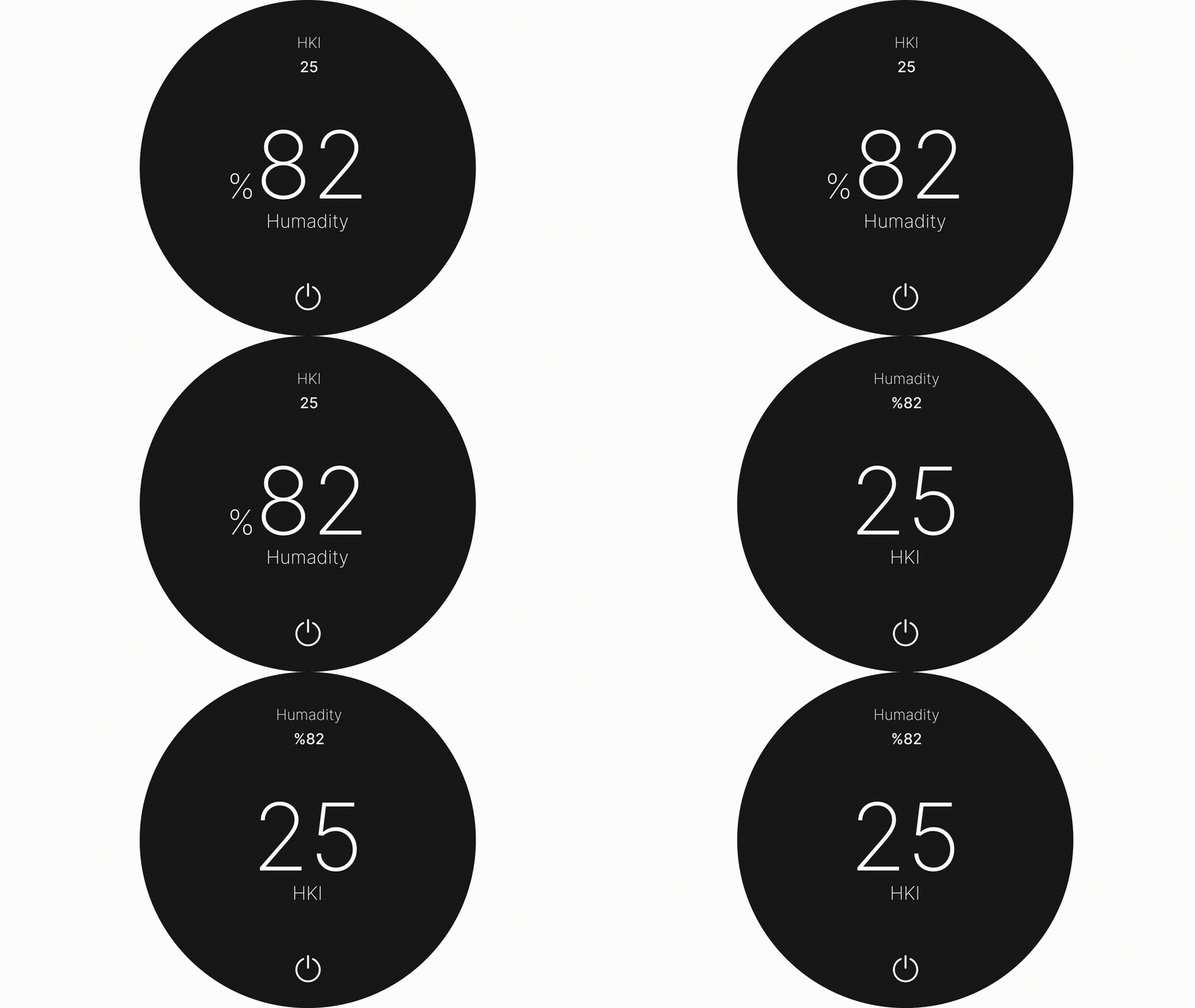
View humidity and AQI values with touch screen.
CHANGING FILTERS
The filter cover is opened with the slide switch. The Active Carbon Filter, True Hepa Filter, and Pro Filter are removed.
REMOVING THE WATER TANK
Details

COVER BUTTONS


FILTER COVER
FEEDBACK SCREEN

ROOM FRAGRANCES
Exploded View
The product design was inspired by nature as a visual form; however, the device technically includes a high-performance air filter.

Carbon Fiber Evaporator Air Humidification Filter
- Active Carbon Filter
- True Hepa Filter
- Pro Filter

Room Fragrances
COMING SOON...


Brand Identity
How do I create a fun and engaging brand identity for potential Cactus users?
I aimed to continue the #0F5940 coded color that I determined as the main color during the product design process in the brand identity.
Then I searched for a fun and round font that would match Cactus's user base and product form. This search led me to the Usurp Regular font style.

I focused on a simple and plain design for the packaging. By avoiding intense colors, I aimed to prevent issues such as boxes getting wet from weather conditions and the paint running during logistics.
This strategy also reduces production costs by using less paint, opting for only black.


App Design
COMING SOON...
Web Design
COMING SOON...
* This project is an individual concept study. During the development process, a special focus was placed on form-function balance, user habits and emotional connection.
Although no real user tests were conducted, a design was constructed based on scenarios.